Test a model API
The problem. You are choosing between models, or you have pinned one and need to know when a new snapshot of it changes behaviour. Vendor benchmarks answer neither question — they measure a general capability, and you care about your prompts, your cases, and the answer changing under you.
The shape. One provider block per model, the same prompts and cases across all of them, and a budget assertion so a run cannot get expensive without you noticing.
1. Declare the model
Both native clients take the same four things — a model id, an endpoint, the name of an environment variable holding the key, and a params object.
  - id: claude
    label: "claude-haiku-4-5"
    type: anthropic
    model: "claude-haiku-4-5"
    # ANTHROPIC_BASE_URL is what the vendor's own tooling honours, so pointing
    # this at a gateway needs no edit here.
    base_url: "${env:ANTHROPIC_BASE_URL:-https://api.anthropic.com}"
    api_key_env: ANTHROPIC_API_KEY
    params:
      max_tokens: 512
    # USD per million tokens. Only the fields you state are overridden.
    pricing:
      input_per_mtok: 1.00
      output_per_mtok: 5.00
      cache_read_per_mtok: 0.10
      cache_write_per_mtok: 1.25
Calls POST {base_url}/v1/messages. ANTHROPIC_BASE_URL is what the vendor's own tooling honours, so putting a gateway in front needs no edit here.
  - id: gpt
    # The label interpolates the same variable as `model`: it exists to name
    # the system under test wherever results are displayed, and a run against
    # qwen3:4b must not report itself as gpt-4o-mini.
    label: "${env:OPENAI_MODEL:-gpt-4o-mini}"
    type: openai
    model: "${env:OPENAI_MODEL:-gpt-4o-mini}"
    # Defaults to the real API, and redirects with one variable — the same one
    # the vendor's own SDK honours, so a gateway, a proxy or a local Ollama
    # needs no edit to this file.
    base_url: "${env:OPENAI_BASE_URL:-https://api.openai.com/v1}"
    api_key_env: OPENAI_API_KEY
    # Passed through to the API verbatim. temperature 0 is not a guarantee of
    # determinism, but it removes the largest source of run-to-run noise.
    params:
      temperature: 0
      max_tokens: 256
Calls POST {base_url}/chat/completions — which is the lingua franca. OpenAI itself, vLLM, LiteLLM, OpenRouter, Together, and a local Ollama all accept it, so this one block covers most of the market. See Local LLMs for the loopback case.
Two rules about secrets, and both are load-bearing:
api_key_envnames the variable, never the key. The value is read at call time and never enters the suite, the cache key, or a shared run — which is what lets two teammates with different keys share cache entries instead of each paying separately.${env:VAR:-default}resolves at load time and does enter the cache key. Use it for things that change the answer — endpoint, model, mode — and never for credentials.
A label is worth setting whenever model is interpolated. It is the string the UI and every report use to name the system under test, and a run against one model must not report itself as another.
2. Compare two models in one run
A run is a grid of providers × prompts × tests, so a second provider does not replace the first — it doubles the cells and gives you a column to read against.
providers:
  - id: haiku
    label: "claude-haiku-4-5"
    type: anthropic
    model: "claude-haiku-4-5"
    api_key_env: ANTHROPIC_API_KEY
    params: { max_tokens: 512 }
  - id: mini
    label: "gpt-4o-mini"
    type: openai
    model: "gpt-4o-mini"
    api_key_env: OPENAI_API_KEY
    params: { max_tokens: 512, temperature: 0 }
The matrix view pivots that run to one column per provider, which is the view that answers "better on what" rather than "better". Scope a single run to one of them with --provider mini when you only want to re-measure one side.
3. Pass parameters through, verbatim
params is sent to the API as-is. domarinn sets only model and the messages; it forces no temperature and invents no defaults, so anything the vendor accepts is available without waiting for a domarinn release.
The Messages API requires max_tokens, so domarinn fills in 4096 when your params omit it. Set it deliberately rather than inheriting that.
Params are part of the cache key, so changing one re-asks rather than replaying — which is the point. See Providers for the exact field list per type.
4. Make cost a fact, not a hope
domarinn ships a rate table for the models it knows and prices every call from it, so cost_usd, the run-level total, and a cost: budget all mean something with no configuration. A model it does not know — a preview snapshot, a negotiated rate, a gateway that rebills — prices at nothing, and then a cost: assertion passes as "cost not reported; budget not enforced". Green, enforcing nothing.
State the price whenever you are not on public list rates:
    pricing:
      input_per_mtok: 1.00
      output_per_mtok: 5.00
      cache_read_per_mtok: 0.10
      cache_write_per_mtok: 1.25
Pricing is merged field-wise over the built-in rates and is deliberately not part of the cache key: cost_usd is recomputed on every cache hit from the stored token counts and the current rate sheet, so correcting a price re-prices your history instead of discarding it.
Then bound the run. Example 31 is the whole subject — cost, token and latency budgets, and the ways each of them can quietly enforce nothing:
See Pricing for what is priced (graders included, and reported separately) and budget assertions for their exact semantics.
5. Grade what a substring cannot
Deterministic assertions get you further than people expect, and they should always run first — they are free and they short-circuit the expensive ones. When the property you care about genuinely needs judgment, add an llm-rubric and pin the grader separately from the system under test:
grader:
  provider:
    type: anthropic
    model: "claude-haiku-4-5"
    api_key_env: ANTHROPIC_API_KEY
    params: { max_tokens: 4096 }
  verdict_mode: forced
A model grading its own output is not an independent measurement. The mechanics — verdict shape, fail-closed truncation, per-assert grader overrides, what grading costs — are in Grading, and writing a rubric that measures one thing is Guide 07.
If what you need to measure is a tool decision rather than prose, that is its own shape: declare tools: and assert on the tool_calls the model reports back. Over the native Anthropic API that is example 35; over your own program it is example 15. Declaring a tool never makes domarinn run one.
6. Share the run, then keep the history
A local run prints and exits. --share uploads it to a results server, and that is when a suite turns into a trend:
$ export DOMARINN_SERVER_URL=https://domarinn.example.com
$ export DOMARINN_TOKEN=<write-scoped token>
$ domarinn run eval/models.yaml --share
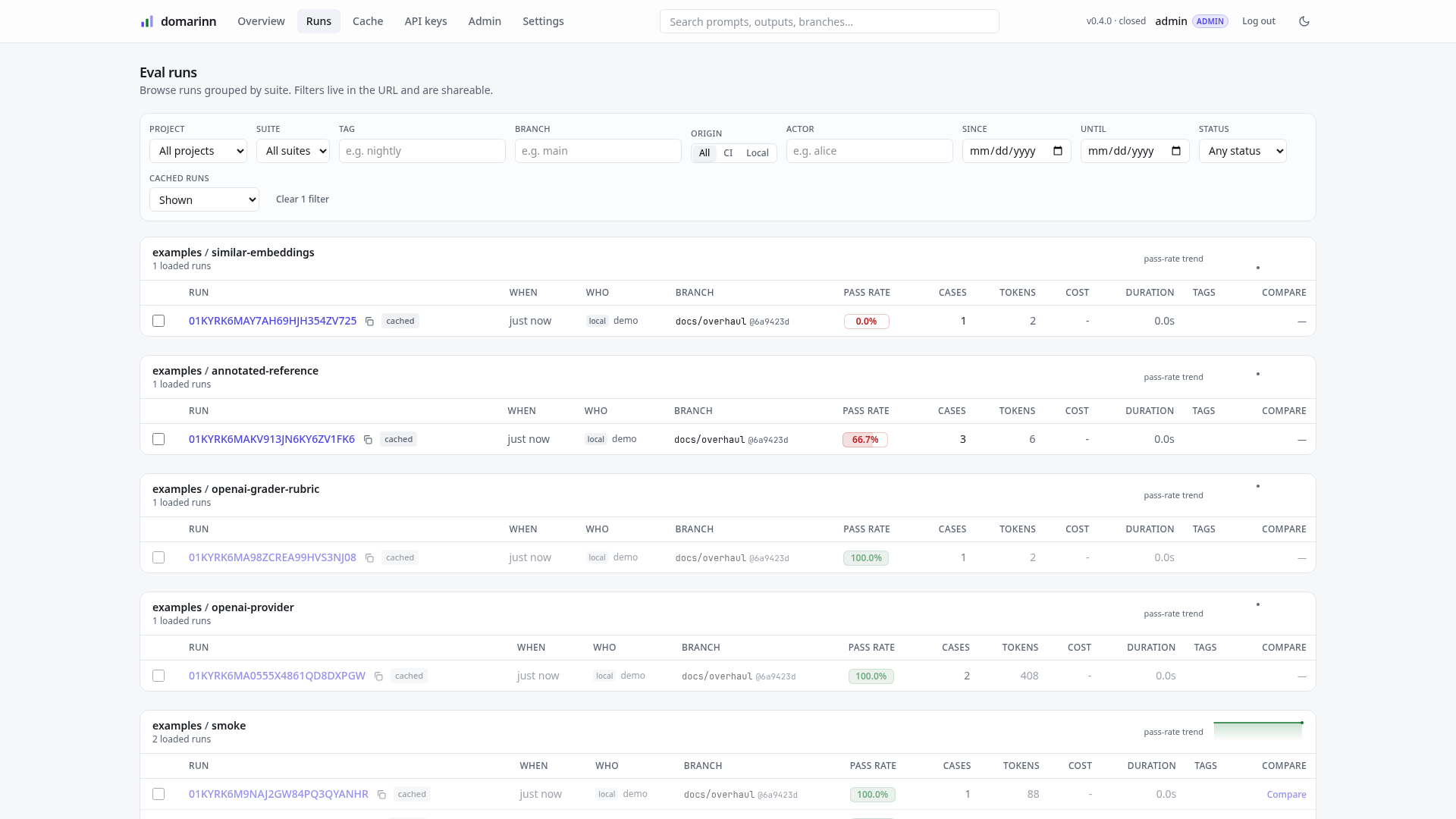
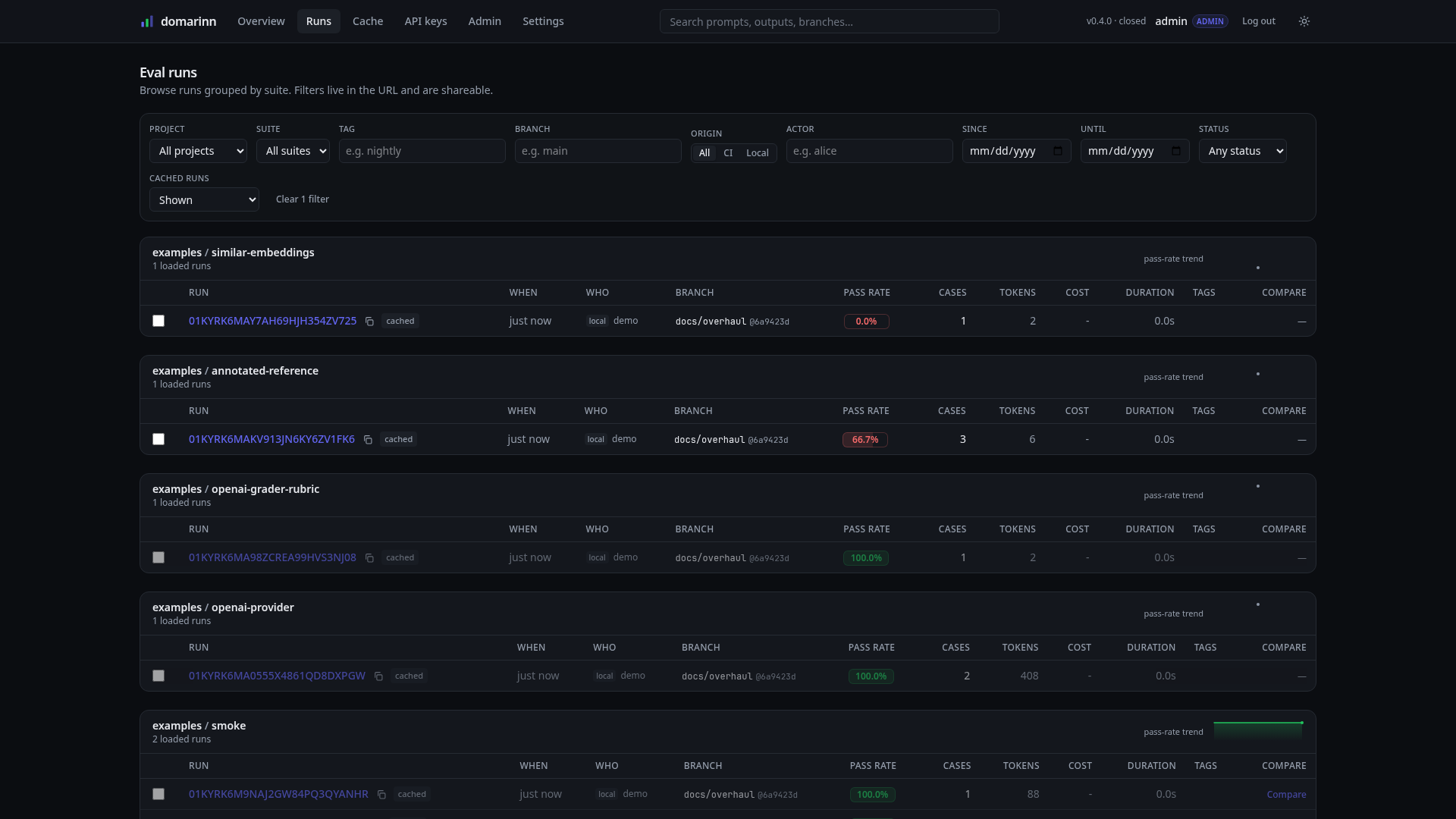
Shared runs land grouped by suite with a pass-rate sparkline per group, and every row carries who ran it, the branch and commit it ran against, and the token and cost totals — which is what makes "did that model snapshot change anything" a question you can answer next month instead of re-running from scratch. COST is a dash on every row above because a local model served those runs, and a model with no published rate has nothing to total. Filters live in the URL, so a link is a saved view.
From there, --against server:baseline gates a run against a pinned reference, and the compare view tells you whether a difference is real or noise. See Gate a PR in CI.
See also
- Example 26 and example 27 — the two provider blocks above.
- Providers — every field of every provider type.
- Local LLMs with Ollama — the same suites, zero spend, no key.
- Test your app via exec — when the thing you ship is not the model.