Local LLMs with Ollama
The problem. Every graded eval you write costs money to run and needs a secret to run at all — which means you cannot iterate on a rubric at your desk without paying per attempt, cannot put a graded suite in CI without provisioning a key, and cannot point any of it at customer text without sending that text to a vendor.
The shape. Serve an OpenAI-compatible endpoint on localhost, and redirect one variable. Nothing in a suite changes.
Three things make this work, and they are already in the suites you have:
type: openaispeaks chat-completions, which Ollama serves at/v1. So does vLLM, LiteLLM, and most gateways.- Every endpoint in the shipped examples is
${env:OPENAI_BASE_URL:-…}— the same variable OpenAI's own SDK honours. - A grader is a provider like any other, so the same redirect moves the grader too.
1. Bring up a local endpoint
The repository's docker-compose.yml carries an ollama service behind its own profile, so a plain docker compose up never starts it:
docker compose --profile ollama up -d --wait ollama
docker compose --profile ollama exec ollama ollama pull qwen3:4b
The service publishes 11434 and keeps its models in a named volume, so a down does not cost you the download. To run on an NVIDIA GPU, uncomment the deploy.resources.reservations.devices block at the bottom of the service (it needs the NVIDIA Container Toolkit on the host).
If Ollama is installed on the host, there is nothing to orchestrate:
Models want a GPU and laptops usually do not have one. Forward the port instead of exposing the service:
Everything below then works unchanged, because the endpoint is still localhost from domarinn's point of view — and the machine that holds the GPU never listens on a network.
Confirm it is up before blaming a suite:
2. Redirect one variable
The provider in example 26 is written to be moved:
  - id: gpt
    # The label interpolates the same variable as `model`: it exists to name
    # the system under test wherever results are displayed, and a run against
    # qwen3:4b must not report itself as gpt-4o-mini.
    label: "${env:OPENAI_MODEL:-gpt-4o-mini}"
    type: openai
    model: "${env:OPENAI_MODEL:-gpt-4o-mini}"
    # Defaults to the real API, and redirects with one variable — the same one
    # the vendor's own SDK honours, so a gateway, a proxy or a local Ollama
    # needs no edit to this file.
    base_url: "${env:OPENAI_BASE_URL:-https://api.openai.com/v1}"
    api_key_env: OPENAI_API_KEY
    # Passed through to the API verbatim. temperature 0 is not a guarantee of
    # determinism, but it removes the largest source of run-to-run noise.
    params:
      temperature: 0
      max_tokens: 256
$ OPENAI_BASE_URL=http://localhost:11434/v1 \
  OPENAI_API_KEY=ollama \
  OPENAI_MODEL=qwen3:4b \
  domarinn run examples/26-openai-provider
OPENAI_API_KEY still has to be set: the client sends a bearer token unconditionally, and domarinn's credential preflight fails with exit 2 — naming the provider and the variable — before it makes a single call. Ollama ignores the value, so any non-empty string does. It is named by api_key_env, so whatever you put there never enters the suite, the cache key, or a shared run.
Note what label does in that fragment: it interpolates the same variable as model. A run against qwen3:4b reports itself as qwen3:4b on every page of the UI. A label hard-coded to gpt-4o-mini would quietly attribute local results to a model you never called, and eval results that misname the system under test are worse than no results.
Cost is not reported, and that is not the same as zero
A local model is not in domarinn's rate table, so cost_usd is unset rather than 0. Every cost: budget in the suite then passes as "cost not reported; budget not enforced" — green, and enforcing nothing. That is fine while you are iterating locally; it is a trap if the same suite is your CI gate. Token budgets still work, because token counts are real.
3. Move the grader too
Example 33 is example 29's rubric with an OpenAI-shaped grader, which means any OpenAI-compatible endpoint can judge:
grader:
  provider:
    type: openai
    # Redirects with the same variable OpenAI's own SDK honours, and the same
    # one example 26 uses for a provider — here it moves the GRADER instead.
    model: "${env:OPENAI_MODEL:-gpt-4o-mini}"
    base_url: "${env:OPENAI_BASE_URL:-https://api.openai.com/v1}"
    api_key_env: OPENAI_API_KEY
    params:
      # See example 29: a thinking-capable grader can truncate a structured
      # verdict at a small ceiling, which is a fail-closed error, not a
      # silent pass. Generous costs nothing extra — you are billed for
      # tokens actually generated.
      max_tokens: 4096
  # `forced` is the default and the only value the loader accepts. `auto` is in
  # the schema but was never implemented, so `domarinn validate` rejects it
  # rather than quietly forcing anyway.
  verdict_mode: forced
  timeout_ms: 120000
$ OPENAI_BASE_URL=http://localhost:11434/v1 OPENAI_API_KEY=ollama OPENAI_MODEL=qwen3:4b \
  domarinn run examples/33-openai-grader-rubric
The system under test in that suite is the offline echo provider, so the only thing reaching a network is the grader. That is the shape to reach for when you want to develop a rubric: the answers are fixed, the verdict is the variable, and each attempt is free.
Raise max_tokens and mean it. A thinking-capable model spends tokens before it emits the structured verdict, and a truncated verdict is a fail-closed error, not a silent pass. 4096 above is not generosity — you are billed for tokens generated, and locally you are billed nothing at all.
A local grader is a different grader
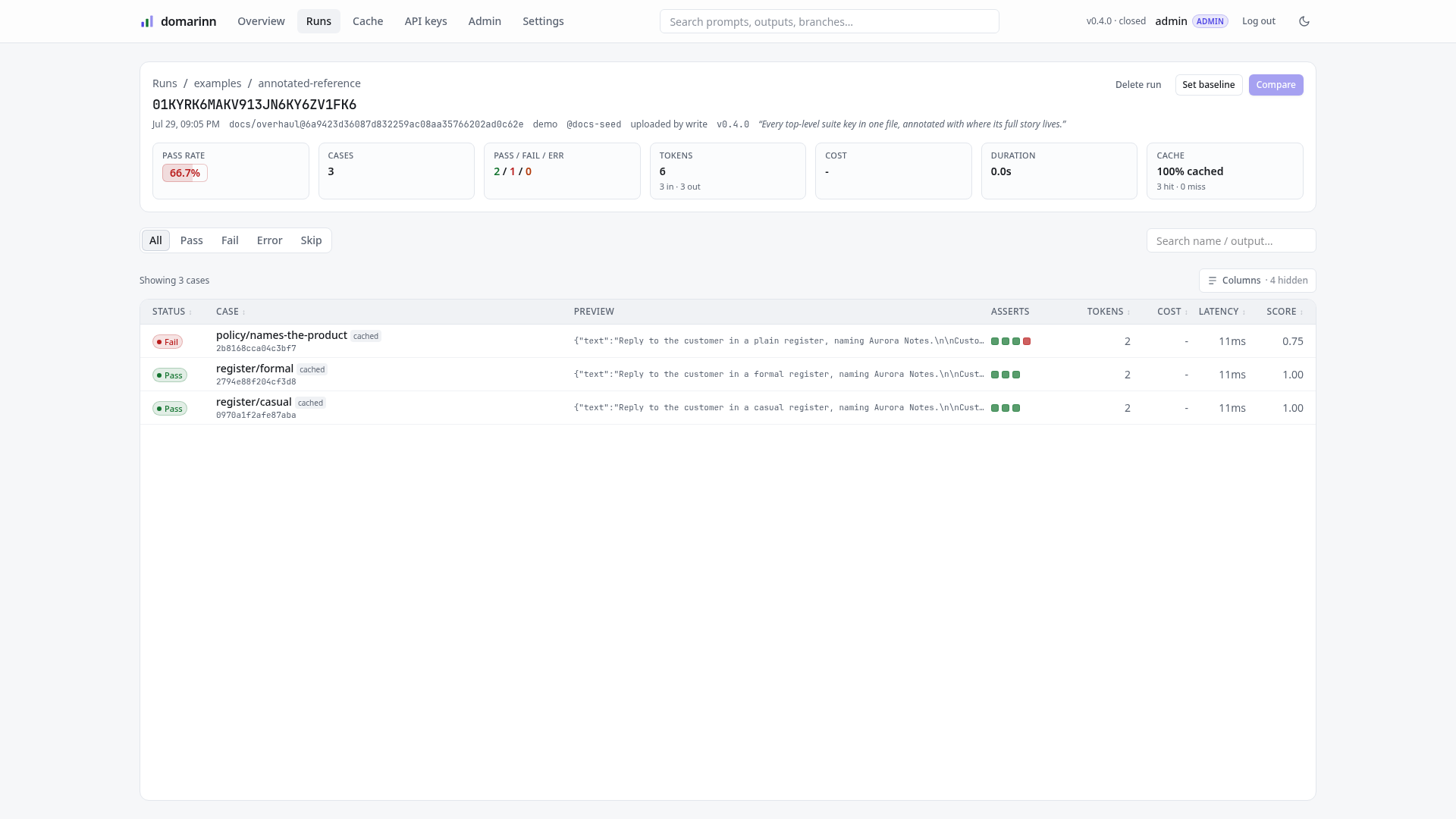
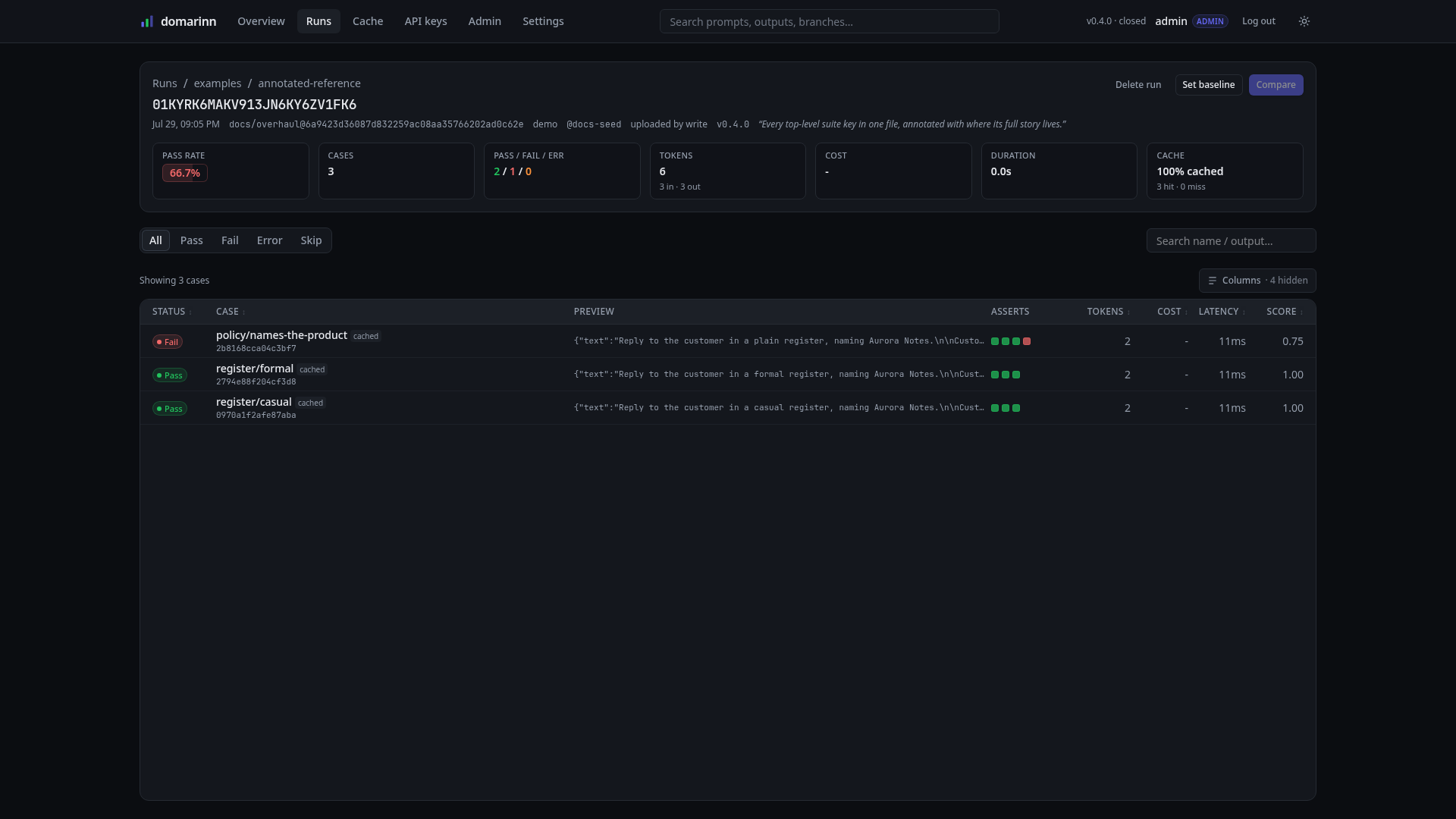
That is a real run of example 38 graded by qwen3:4b on loopback, and it is worth showing precisely because it is not all green. Three cases, two passed, one failed at 0.75 — and the red square in that row's assert strip is the llm-rubric. The rubric asks one thing ("does the text name the product the customer is being answered about") and explicitly says not to penalise the response for reading as an instruction rather than an answer. The 4B grader answered:
The text names "Aurora Notes" (a product), but the customer's question is about a jacket. The rubric requires the text to name the product the customer is being answered about (the jacket), not a different product.
A frontier grader scores that case 1.00. Neither verdict is a bug: a rubric is calibrated against a grader, and a smaller model reads instructions more literally and volunteers more opinions. So use a local grader for the loop you iterate in, and re-calibrate — or re-baseline — when you change the model that grades. Note also the COST – and the 100% cached on this run: verdicts are cached per grader identity, which brings us to the caveat below.
4. What runs locally, and what does not
Not every example can be pointed at Ollama, and the reason is always the wire shape, never the model.
| Example | Local? | Why |
|---|---|---|
| 26 — an OpenAI-compatible endpoint | yes | type: openai; set OPENAI_BASE_URL + OPENAI_MODEL. |
| 30 — similarity | yes | type: embeddings is also OpenAI-compatible. Add OPENAI_EMBED_MODEL=nomic-embed-text — a chat model does not serve /v1/embeddings. |
| 32 — a live endpoint | yes | Endpoint, model and key are all ${env:…} with no defaults. See below. |
| 33 — an OpenAI-shaped grader | yes | Its grader is type: openai, so the same variable moves it. |
| 38 — every key, once | yes | Offline system under test, type: openai grader. This is how CI runs it. |
| 27 — Anthropic, and what it costs | no | type: anthropic speaks the Messages API. Ollama does not serve that shape. |
| 35 — Anthropic tools, natively | no | Same wire shape, and the whole point of the example is the native tool block. |
| 29 — LLM-rubric grading | no | Its grader is type: anthropic. Use 33 instead — same rubric, OpenAI-shaped grader. |
| 28 — a service you already run | n/a | type: http posts your body shape to your endpoint; there is no model to relocate. See Test an HTTP endpoint. |
36 — output_expr, sliced two ways |
n/a | Same: an arbitrary HTTP service, not a model API. |
To reach an Anthropic-shaped model from a local endpoint you need a gateway that translates (LiteLLM does), pointed at with ANTHROPIC_BASE_URL. Reaching for type: openai instead is usually less work.
Which model
| Job | Start with | Why |
|---|---|---|
| System under test | qwen3:4b |
Small enough to be fast on a CPU, coherent enough that a suite's assertions mean something. |
| Grader | a larger qwen3 |
Verdicts are where model size shows. A 4B grader works and is what CI uses, but expect it to be stricter and noisier than a frontier one. |
| Embeddings | nomic-embed-text |
A real embedding model. Chat models do not serve /v1/embeddings at all — the assertion errors rather than passing. |
A similar threshold does not transfer between embedding models: cosines are not comparable across them. Example 30's threshold: 0.85 was chosen against a hosted model and scores around 0.76 under nomic-embed-text on the same paraphrase — a real fail, on a case that is genuinely a paraphrase. Re-choose the threshold for the model you run, and see Troubleshooting for the other direction of that trap.
5. Wire your own endpoint, per developer
Example 32 is deliberately unrunnable as shipped: every ${env:VAR} in it has no default, so it names an endpoint only its reader has. That is the pattern for a post-deploy smoke suite, and the place to put those values is a per-developer file your VCS ignores. In this repository that is .mise/config.local.toml:
# .mise/config.local.toml — git-ignored; never commit an endpoint or a key.
[env]
DOMARINN_SMOKE_BASE_URL = "http://localhost:11434/v1"
DOMARINN_SMOKE_MODEL = "qwen3:4b"
DOMARINN_SMOKE_API_KEY = "ollama"
An unset ${env:VAR} without a default fails at load time, with the variable named — so a missing value is a clear error before any call is made, not a mysterious 401 halfway through a run.
The endpoint is stored in the run
A run's config_snapshot holds the resolved base_url, and the server returns it verbatim to the compare view. Point a suite at a private host, --share the run, and that hostname is now in your results database and in any screenshot of it. Keep private endpoints in ignored local config, and keep loopback in anything you publish.
6. The caveat that surprises everyone
${env:VAR} resolves at load time, which means the substituted value is part of the cache key. That is deliberate, and it is the behaviour you want:
- Switch
OPENAI_BASE_URLfrom the hosted API tolocalhost:11434and the whole suite re-runs. Two different endpoints served two different answers; replaying one for the other would be a lie. - Switch
OPENAI_MODELand the same thing happens, including for the grader — grader identity is in the key, so grading a case withgpt-4o-miniand then withqwen3:4basks the second grader rather than replaying the first one's verdict.
The corollary: a warm local cache does not make your hosted runs cheaper, and it should not. Credentials are the exception — api_key_env names a variable whose value is read at call time and never keyed, so two teammates with different keys share cache entries instead of each paying separately. See Caching → what is in the key and which env syntax.
See also
- Example 26 and example 33 — the suites above.
- Test a model API — the same suites pointed at a vendor, with pricing and budgets.
- Grading — verdict mechanics, and what an OpenAI-shaped grader sends.
- Providers →
openai— the full field list, including a gateway example.